Features of Buenos Aires
Location
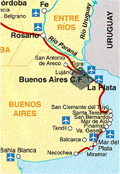 The City of Buenos Aires is the capital of the Argentine Republic and is located in the southern hemisphere, latitude 34º 36’ and longitude 58º 26’. The city extends on a plain and has 202 square kilometers (78.3 sq miles). Approximately 3 million people live in this city. Including the metropolitan area, the total population of Buenos Aires is more than 12 million, making it one of the 10 most populated urban centers in the world. The City of Buenos Aires is the capital of the Argentine Republic and is located in the southern hemisphere, latitude 34º 36’ and longitude 58º 26’. The city extends on a plain and has 202 square kilometers (78.3 sq miles). Approximately 3 million people live in this city. Including the metropolitan area, the total population of Buenos Aires is more than 12 million, making it one of the 10 most populated urban centers in the world.
The Río de la Plata and the Riachuelo are the natural borders of the city on the east and south, respectively. The rest of the metropolitan perimeter is surrounded by the General Paz Avenue from north to west. This avenue provides a fast connection between the city and the Greater Buenos Aires, a densely populated area with important business and industrial activity.
Up
Climate
The climate of Buenos Aires is mild all year round. The mean annual temperature is 18º C (64.4º F), making extremely hot and cold days very infrequent. Thus, visitors can enjoy walking around the city in any season.
July is the coldest month. Although frosts are rare, a woolen coat, a jacket or an overcoat and a scarf will be required when going out. In winter, cold is moderate during the day, but temperature considerably drops at night.
In summer, the weather is hot and humid. Mornings are warm and during midday and the first hours of the afternoon, the temperature rises. At night, temperature goes down slightly, so people may wear light clothes; coats are not needed.
Rains are more frequent in autumn and spring (from March to June and from September to December, respectively). They are mild or last a short time, thus activities are not hampered and people usually go out with an umbrella or a raincoat.
In the sunny days of autumn and spring, mornings are slightly cold; the temperature rises at midday and drops again at night.
Up
Tourism
According to the World Travel & Tourism Council, tourism has been growing in the Argentine capital since 2002. In a survey by the travel and tourism publication Travel + Leisure Magazine in 2008, travelers voted Buenos Aires the second most desirable city to visit after Bangkok, Thailand.
The city offers a variety of cultural activities. Visitors may choose to visit a tango show, an estancia in the Province of Buenos Aires, or enjoy the traditional asado. New tourist circuits have recently evolved, devoted to famous Argentines such as Carlos Gardel, Eva Perón or Jorge Luis Borges. Due to the favourable exchange rate, its shopping centres such as Alto Palermo, Paseo Alcorta, Patio Bullrich, Abasto de Buenos Aires and Galerías Pacífico are frequently visited by tourists. Non-traditional tourist options such as downloadable MP3 tours of Buenos Aires and bike tours have recently gained popularity.
San Telmo is a frequently visited area south of city, with its cobblestoned streets and buildings from the colonial era that attest to its long history. There are churches, museums, antique shops and "Antique Fairs" ('Ferias de Antigüedades') in historic Dorrego Square, where the streets on weekends are filled with performers such as tango dancers. The city also plays host to musical festivals, the largest of which is Quilmes Rock.
Up
Tango
Tango music was born in the suburbs of Buenos Aires, notably in the brothels of the Junín y Lavalle district and in the arrabales (poorer suburbs). Its sensual dance moves were not seen as respectable until adopted by the Parisian high society in the 1920s, and then all over the world. In Buenos Aires, tango-dancing schools (known as academias) were usually men-only establishments.
Tango consists of a variety of styles that developed in different regions and eras of Argentina and Uruguay as well as in other locations around the world. The dance developed in response to many cultural elements, such as the crowding of the venue and even the fashions in clothing. The styles are mostly danced in either open embrace, where lead and follow connect at arms length, or close embrace, where the lead and follow connect chest-to-chest.
Early tango was known as tango criollo, or simply tango. Today, there are many tango dance styles, including Argentine Tango, Uruguayan Tango, Ballroom tango (American and International styles), Finnish tango and vintage tangos.
Up
Customs
Buenos Aires has always been an open-door city. Its inhabitants are called porteños, which makes reference to the fact that the city is a port. The inhabitant of the province of Buenos Aires is called bonaerense.
Porteños are warm and hospitable: they usually invite tourists for lunch or dinner at their homes and prepare typical food. A tipical drink which you will often see
locals drinking is called mate.
 It is prepared by pouring warm water into a gourd, also called mate that contains yerba mate. It is then drunk using a metal straw-like apparatus called a bombilla. Some people add sugar, but most prefer their mate “amargo” (bitter, or without sugar). It is prepared by pouring warm water into a gourd, also called mate that contains yerba mate. It is then drunk using a metal straw-like apparatus called a bombilla. Some people add sugar, but most prefer their mate “amargo” (bitter, or without sugar).
Up
Religion
Argentina recognizes the freedom of worship. The official religion Roman Catholicism, illustrated by an impressive number of churches. There are also other places of public worship, such as the Jewish central synagogue, the only site providing training to rabbis from all around the world, and the Mosque of Palermo neighborhood, the largest Islamic temple in Latin America.
Up
Language
The official language is Spanish. Something to note is the use of “vos” (you) instead of the Spanish “tú” for informal uses. Another characteristic of Argentine Spanish is the use of “che” to address a person.
Up
Economy
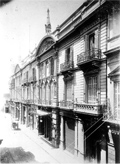 Buenos Aires is the financial, industrial, commercial, and cultural hub of Argentina. Its port is one of the busiest in South America; navigable rivers by way of the Rio de la Plata connect the port to north-east Argentina, Brazil, Uruguay and Paraguay. Buenos Aires is the financial, industrial, commercial, and cultural hub of Argentina. Its port is one of the busiest in South America; navigable rivers by way of the Rio de la Plata connect the port to north-east Argentina, Brazil, Uruguay and Paraguay.
As a result it serves as the distribution hub for a vast area of the south-eastern region of the South American continent. Tax collection related to the port has caused many political problems in the past
The economy in the city proper alone, measured by Gross Geographic Product (adjusted for purchasing power), totalled US$ 84.7 billion (US$ 30,525 per capita) in 2006 and amounts to nearly a fourth of Argentina's as a whole. Metro Buenos Aires, according to one well-quoted study, constitutes the 13th largest economy among the world's cities. The Buenos Aires Human Development Index (0.923 in 1998) is likewise high by international standards.
To the west of Buenos Aires is the Pampa Húmeda, the most productive agricultural region of Argentina produces wheat, soybeans and corn (as opposed to the dry southern Pampa, mostly used for cattle farming and more recently production of premium Buenos Aires wines). Meat, dairy, grain, tobacco, wool and leather products are processed or manufactured in the Buenos Aires metro area. Other leading industries are automobile manufacturing, oil refining, metalworking, machine building and the production of textiles, chemicals, clothing and beverages.
Up
Porteños
The people of Buenos Aires are known as porteños (people of the port), acknowledging the historical importance of the port in the development of the city and the nation. Suburbanites are called porteños and sometimes bonaerenses (the demonym of the Buenos Aires province).
According to the census, the city proper has a population of 2,776,138, while the Greater Buenos Aires conurbation has more than 12.4 million inhabitants (2001 census).
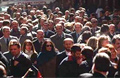 Most porteños have European origins, with Spanish and Italian descent being the most common, mainly from the Galician, Asturian, and Basque regions of Spain, and the Calabrian, Ligurian, Piedmont and Neapolitan regions of Italy. Most porteños have European origins, with Spanish and Italian descent being the most common, mainly from the Galician, Asturian, and Basque regions of Spain, and the Calabrian, Ligurian, Piedmont and Neapolitan regions of Italy.
Other European origins include German, Portuguese, Polish, Irish, French, Croatian and English.
In the 1990s, there was a small wave of immigration from Romania and Ukraine.
There is a small minority of an old criollo population, dating back to the Spanish colonial days. Criollo and Spanish-aboriginal (mestizo) population in the city has increased mostly as a result of migration, both from the provinces and from nearby countries such as Bolivia, Perú and Paraguay, since the second half of the 20th century.
Important Arab (mostly Syrian-Lebanese) and Armenian communities have been significant in commerce and civic life since the beginning of the 20th century.
 Buenos Aires’s Jewish community, numbering around 250,000, is the largest Jewish community in Latin America. Most are of Eastern European Ashkenazi origin, with a significant minority of Sephardim, mostly Syrian Jews. Buenos Aires’s Jewish community, numbering around 250,000, is the largest Jewish community in Latin America. Most are of Eastern European Ashkenazi origin, with a significant minority of Sephardim, mostly Syrian Jews.
The first major East Asian community in Buenos Aires was the Japanese, most notably from Okinawa. Traditionally, Japanese-Argentines were noted as flower growers; in the city proper, there was a Japanese near-monopoly in dry cleaning. Later generations have branched into all fields of activity. Ever since the 1970s there has been an important influx of immigration from China and Korea.
Up
Where to eat?
The city of Buenos Aires holds more than 3,500 restaurants, ranging from the most sophisticated traditional and ethnic restaurants to bars, pubs and international chains of fast food restaurants. The classical parrillas offering Argentine roasted meat abound, even in the sidewalks.
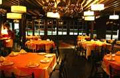 Buenos Aires is just the place to taste all kinds of meals. Some neighborhoods are a typical choice when you decide to have a good meal. Puerto Madero, in the remodeled port docks, has the most exclusive restaurants. Palermo, in the surroundings of Serrano square, and Palermo Hollywood and Las Cañitas, are the fashionable gastronomic places. They offer meals from different countries of the world together with the latest trend in ambiance – a combination that mixes the minimalist style with extravagant and traditional dishes, jazz and electronic music. Corrientes avenue is the ideal place to taste an excellent pizza. Buenos Aires is just the place to taste all kinds of meals. Some neighborhoods are a typical choice when you decide to have a good meal. Puerto Madero, in the remodeled port docks, has the most exclusive restaurants. Palermo, in the surroundings of Serrano square, and Palermo Hollywood and Las Cañitas, are the fashionable gastronomic places. They offer meals from different countries of the world together with the latest trend in ambiance – a combination that mixes the minimalist style with extravagant and traditional dishes, jazz and electronic music. Corrientes avenue is the ideal place to taste an excellent pizza.
Hours: In Buenos Aires, people usually have dinner after 10 pm, and some restaurants are open until dawn. While in Paris, New York or London restaurants are crowded at about 8:30 pm, this generally happens in Buenos Aires after 11 pm. Most of them are open every day, for lunch and dinner, although on Mondays, they may be closed. It´s a good idea to call in advance.
Find what are you looking for here:
http://www.restaurant.com.ar/
http://www.restospuertomadero.com.ar
http://www.palermohollywood.net/
Up |


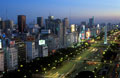 Currently, Buenos Aires receives tourists from varied nationalities that come for different purposes. Some come to shop, others to enjoy the night life and some others to taste the porteños bohemian lifestyle. Also, there are those who engage in an educational tour and want to study the Spanish language.